
Blogs

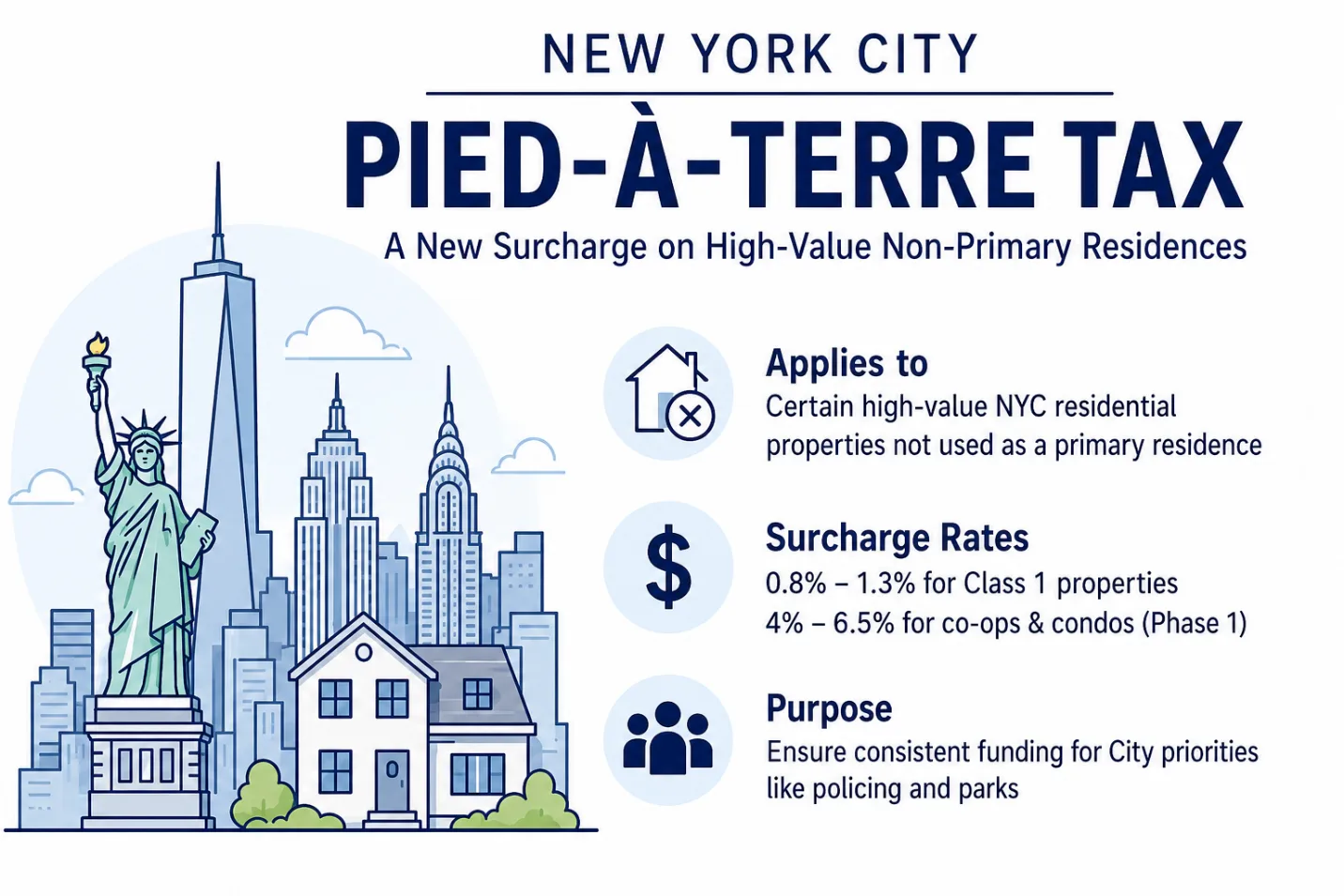
New York State has enacted a new surcharge on certain high-value residential properties in New York City that are not used as a qualifying primary residence. Commonly referred to as the “pied-à-terre” tax, the surcharge is administered by the New York City Department of Finance and is designed to generate additional revenue from luxury homes that serve as second homes or investment properties rather than full-time residences.

Which Properties Are Affected?

The surcharge applies to certain:

  • Tax Class 1 residential properties (includes most 1-3 family homes and most condos that are not more than 3 stories)
  • Tax Class 2 Residential condominium units
  • Tax Class 2 Residential cooperative (co-op) units

To be subject to the surcharge, a property must exceed certain market value thresholds and not qualify as the primary residence of:

  • The owner,
  • An immediate family member, or
  • A qualifying tenant occupying the property under an arm’s-length lease with a term of at least one year.

The key question is simple: Does the property qualify as a primary residence? If the answer is yes, the surcharge does not apply.

How the Tax Will Be Phased In

The new surcharge will be implemented in two phases. Phase 1 will be based on existing Department of Finance valuations. Phase 2 will depend on the Department of Finance implementing a new sales-based valuation methodology which will determine the market value of co-ops and condominiums using comparable sales, rather than relying on existing statutory valuation limits. 

Phase 1: July 1, 2026 – June 30, 2028

For Class 1 residential properties, the surcharge applies to homes with a market value of $5 million or more:

  • 0.8% on properties valued between $5 million and $15 million
  • 1.05% on properties valued at more than $15 million up to $25 million
  • 1.3% on properties valued at more than $25 million

For co-ops and condominiums, the threshold is significantly lower during Phase 1, applying to units with a market value of $1 million or more:

  • 4% on properties valued between $1 million and $3 million
  • 5.25% on properties valued at more than $3 million up to $5 million
  • 6.5% on properties valued at more than $5 million

Phase 2: July 1, 2028 – June 30, 2031 (or when the tax terminates)

Beginning in Phase 2, the Class 1 properties utilize the same rates as Phase 1, but comparable sales at market value are utilized. In Phase 2, the rules for co-ops and condominiums generally align with those for Class 1 properties. The tax will be applied based on the Phase 2 Market Value, which will be the Department of Finance’s valuation method that relies on comparable sales of condos and co-ops without considering any statutory discounts. The market value threshold increases to $5 million, and the applicable surcharge rates become:

  • 0.8%
  • 1.05%
  • 1.3%

Are There Any Exemptions?

Yes. Several categories of property are excluded from the surcharge, including:

  • Vacant land
  • Buildings without a certificate of occupancy
  • Unsold sponsor units

In addition, certain two- and three-family homes may be exempt if at least one unit is used as a qualifying primary residence.

The law also includes “look-through” ownership rules for trusts and business entities. These provisions attribute ownership to beneficial owners of trusts and majority owners of partnerships, corporations, and limited liability companies, helping prevent taxpayers from avoiding the surcharge through ownership structures.

Why Was This Tax Created?

The primary purpose of the new surcharge is to provide a consistent source of funding for New York City priorities, including public safety, parks, and other municipal services.

Supporters of the law argue that owners of high-value residences who enjoy the benefits of owning property in New York City, but do not make the city their primary home should contribute more toward the services and infrastructure that help make those properties valuable. By targeting luxury second homes rather than primary residences, lawmakers intend to broaden the City’s revenue base while preserving protections for full-time New York City residents.

Understanding New York’s New “Pied-a-Terre” Tax

New York State has enacted a new surcharge on certain high-value residential properties in New York City that are not used as a qualifying primary residence. Commonly referred to as the “pied-à-terre” tax, the surcharge is administered by the New York City Department of Finance and is designed to generate additional revenue from luxury homes that serve as second homes or investment properties rather than full-time residences.

Which Properties Are Affected?

The surcharge applies to certain:

  • Tax Class 1 residential properties (includes most 1-3 family homes and most condos that are not more than 3 stories)
  • Tax Class 2 Residential condominium units
  • Tax Class 2 Residential cooperative (co-op) units

To be subject to the surcharge, a property must exceed certain market value thresholds and not qualify as the primary residence of:

  • The owner,
  • An immediate family member, or
  • A qualifying tenant occupying the property under an arm’s-length lease with a term of at least one year.

The key question is simple: Does the property qualify as a primary residence? If the answer is yes, the surcharge does not apply.

How the Tax Will Be Phased In

The new surcharge will be implemented in two phases. Phase 1 will be based on existing Department of Finance valuations. Phase 2 will depend on the Department of Finance implementing a new sales-based valuation methodology which will determine the market value of co-ops and condominiums using comparable sales, rather than relying on existing statutory valuation limits. 

Phase 1: July 1, 2026 – June 30, 2028

For Class 1 residential properties, the surcharge applies to homes with a market value of $5 million or more:

  • 0.8% on properties valued between $5 million and $15 million
  • 1.05% on properties valued at more than $15 million up to $25 million
  • 1.3% on properties valued at more than $25 million

For co-ops and condominiums, the threshold is significantly lower during Phase 1, applying to units with a market value of $1 million or more:

  • 4% on properties valued between $1 million and $3 million
  • 5.25% on properties valued at more than $3 million up to $5 million
  • 6.5% on properties valued at more than $5 million

Phase 2: July 1, 2028 – June 30, 2031 (or when the tax terminates)

Beginning in Phase 2, the Class 1 properties utilize the same rates as Phase 1, but comparable sales at market value are utilized. In Phase 2, the rules for co-ops and condominiums generally align with those for Class 1 properties. The tax will be applied based on the Phase 2 Market Value, which will be the Department of Finance’s valuation method that relies on comparable sales of condos and co-ops without considering any statutory discounts. The market value threshold increases to $5 million, and the applicable surcharge rates become:

  • 0.8%
  • 1.05%
  • 1.3%

Are There Any Exemptions?

Yes. Several categories of property are excluded from the surcharge, including:

  • Vacant land
  • Buildings without a certificate of occupancy
  • Unsold sponsor units

In addition, certain two- and three-family homes may be exempt if at least one unit is used as a qualifying primary residence.

The law also includes “look-through” ownership rules for trusts and business entities. These provisions attribute ownership to beneficial owners of trusts and majority owners of partnerships, corporations, and limited liability companies, helping prevent taxpayers from avoiding the surcharge through ownership structures.

Why Was This Tax Created?

The primary purpose of the new surcharge is to provide a consistent source of funding for New York City priorities, including public safety, parks, and other municipal services.

Supporters of the law argue that owners of high-value residences who enjoy the benefits of owning property in New York City, but do not make the city their primary home should contribute more toward the services and infrastructure that help make those properties valuable. By targeting luxury second homes rather than primary residences, lawmakers intend to broaden the City’s revenue base while preserving protections for full-time New York City residents.

Attorney Advertising
Website developed in accordance with Web Content Accessibility Guidelines 2.2.
If you encounter any issues while using this site, please contact us: 631.683.8700